The Cognitive Shuffle: The anti-insomnia tool I use when I can’t sleep


I’ve struggled with insomnia intermittently since I was a child. Partly due to undiagnosed restless leg syndrome coupled with caffeine (turns out the 1980s practice of having Coke with dinner is not useful). I just spent a few days in Barcelona with some friends and my sleep is always worse when I travel.
When this happens, I reach for my favorite tool in my arsenal: the cognitive shuffle. I was first introduced to this technique by Brendan Duffy at a conference and I find it super useful. This technique was originally created by Luc Beaudoin, a cognitive scientist and insomnia sufferer; here is a nice summary from CNN.. Dr. Beaudoin is an academic, writer, and software developer based in Canada.
Here's a complete video on the topic, btw:
How to perform the cognitive shuffle
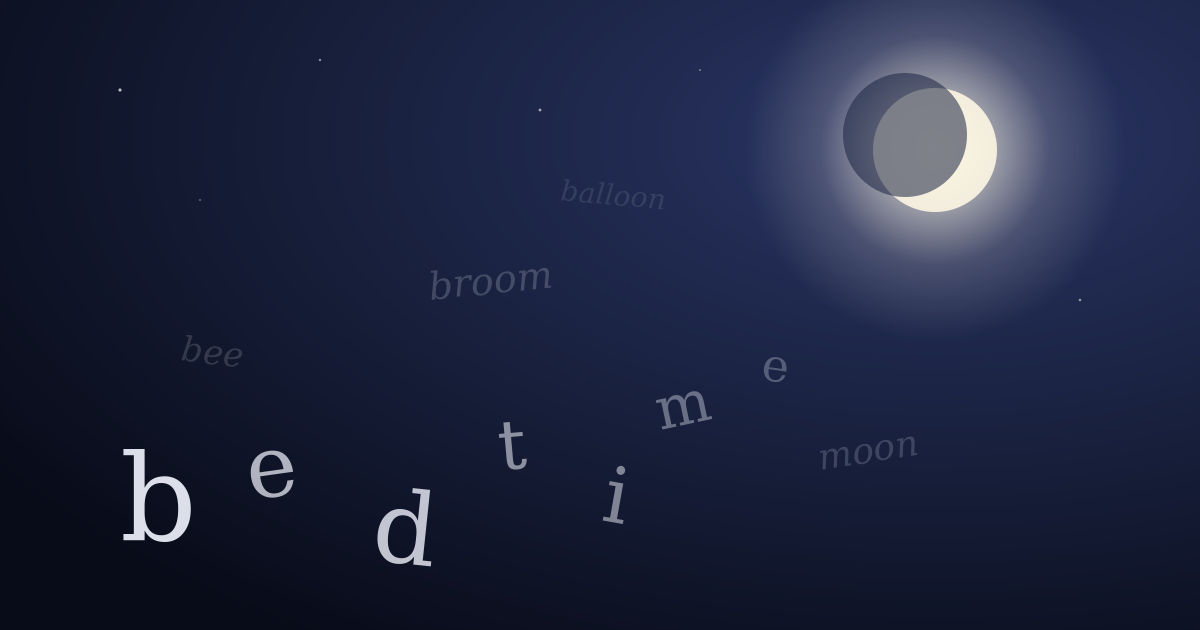
This is really simple. In a nutshell, you pick a word, and come up with as many words starting with each letter of the word. Rinse and repeat. Let’s go through this in a bit more detail.
Let’s say you pick the word “bedtime.”
Begin with the first letter "b" and think of a word that starts with the letter "b". For example "broom". Bring up the mental image of a broom.
Then think of another word that begins with the letter "b" and visualize that word. Don’t stress about the word choice. “Booger” works as well as “beautiful”
Keep going until you run out of words that begin with the letter "b".
Go to the next letter in "bedtime" - "e", and think of words that begin with "e". Visualize the words as you think of them.
Continue at your own pace, but just keep going until you fall asleep. Dr Beaudoin recommends if stressful thoughts come your way, just acknowledge them and go back to shuffling your thoughts instead.
Other tips
- It’s useful to pick a word without repeating letters (like SLEEP) but don’t agonize over word choice. You can just finish your word then go on to the next one
- Don’t keep score. It’s easy to stress yourself if you can’t come up with a lot of words if you are an anxious person (like me). You aren’t trying to get Queen Bee on the NYT Spelling Bee game.
- Sometimes words with a negative or stressful connotation will come up. Just acknowledge them and move on.
- Go slow! Take the time to picture the image associated with the word before you move on.
- You can try matching this with breathing. Breathe in as you come up with the word. Breathe out as you visualize the word. This will slow down your tempo further. Plus, slow exhales activate the parasympathetic system, which helps to calm you down (Magnon et al., 2021) Some people found this helpful, but personally I found it stressful to try to sync up breathing with finding and visualization.
- If you find yourself getting frustrated, take a break.
Why this works
Dr. Beaudoin and his colleagues published a review article in 2020 looking at the thought processes prior to sleep in normal adults and in patients with insomnia. In general, the transition from wakefulness to sleep was characterized by hallucinatory, disconnected imagery.
In the review, they cite an article by Wicklow et al analyzing the thought content of insomnia sufferers prior to sleep. Insomnia sufferers had more unpleasant and less random thoughts. Instead of images, they focused on planning, problem solving, sleep and consequences, arousal status (“I’m wide awake!”), and external noise.
To me, this sounds like what I experience when I can’t sleep—I’m worrying about problems I have, the bad day I will have if I can’t sleep, and bedroom factors (feeling too hot, noticing noises in the house, etc.)
In the CNN article above, the author quotes Dr. Beaudoin:
In addition to taking the mind off one’s worries, cognitive shuffling “resembles in critical respects natural sleep onset,” Beaudoin said.
In the natural transition into sleep, people tend to have “microdreams” and fragmented, nonlinear thought patterns, Beaudoin and Kaylor said. Intentionally engaging in random, disconnected thinking may replicate this cognitive pre-sleep state.
Personally, I have found that using the technique does mimic that feeling I have when I fall asleep more easily—I have disconnected thoughts and dreamlike imagery as I am drifting off.
Research on this technique is limited. Beaudoin et al published an abstract of research studying an analogous method he calls Serial Diverse Imagining Task (SDIT) where external neutral words were given to 154 college students suffering from insomnia, reporting decreased pre-sleep arousal and effort, and improved sleep quality. He also created an app called MySleepButton which replicates this process.
Conclusions
The cognitive shuffle is one of my go-to techniques when I can’t sleep. If you have intermittent insomnia like me, it’s definitely worth trying out. Obviously, this is not a treatment for an underlying sleep disorder. If you are really struggling, check in with your physician.
Sources
- Beaudoin LP, Digdon N, O’Neill K, Racour G. Serial diverse imagining task: A new remedy for bedtime complaints of worrying and other sleep-disruptive mental activity. the American Academy of Sleep Medicine and the Sleep Research Society. Published online March 17, 2016. Accessed June 17, 2026. https://summit.sfu.ca/item/16196
- Lemyre A, Belzile F, Landry M, Bastien CH, Beaudoin LP. Pre-sleep cognitive activity in adults: A systematic review. Sleep Medicine Reviews. 2020;50:101253. doi:10.1016/j.smrv.2019.101253
- Magnon V, Dutheil F, Vallet GT. Benefits from one session of deep and slow breathing on vagal tone and anxiety in young and older adults. Sci Rep. 2021;11(1):19267. doi:10.1038/s41598-021-98736-9
- Rogers K. Cognitive shuffling: A mental trick to help you quiet racing thoughts and fall asleep. CNN. April 8, 2025. Accessed June 17, 2026. https://www.cnn.com/2025/04/08/health/cognitive-shuffling-sleep-technique-benefits-wellness
- Wamsley EJ. Constructive episodic simulation in dreams. PLOS ONE. 2022;17(3):e0264574. doi:10.1371/journal.pone.0264574
- Wicklow A, Espie CA. Intrusive thoughts and their relationship to actigraphic measurement of sleep: towards a cognitive model of insomnia. Behaviour Research and Therapy. 2000;38(7):679-693. doi:10.1016/S0005-7967(99)00136-9
Originally published June 2026. Last reviewed/updated by Dr. Craig Canapari, MD in June 2026
No spam, no sharing to third party. Only you and me.