Why some kids stop napping earlier than others



Nap transitions are a challenging topic— for parents, pediatricians, and sleep consultants. It’s difficult to predict when children when up a nap, and nap transitions are seldom smooth. A whole cottage industry has evolved around predicting nap timing and transitions. Even knowing this, I was surprised when a short reel from our Sleep Edit napping episode really took off on social media.
A shockingly successful video
I share a lot of short excerpts from the podcast on social media. This one outperformed anything I have ever posted before. (When I am writing this on 11/2/25, it has 185K views on Instagram, 117k on TikTok and. . .1.1k views on Youtube, the redheaded stepchild of my social media accounts— please like and subscribe!).
This topic clearly hit a nerve — over 60 comments and counting on my Instagram post about naps and brain development.
Essentially this just briefly recaps a paper from UMass which hypothesized that maturation of part of the brain associated with memory, the hippocampus, is associated with nap transitions.
It made sense intuitively — the idea that as the brain matures, sleep needs change.
What parents were saying
When I posted about the new research linking nap transitions to hippocampal development, the comments section lit up. Dozens of parents and clinicians chimed in with stories, questions, and a fair bit of humor — proof that nap transitions might be the most universal sleep dilemma of early childhood.
There were a few common themes:
Curiosity came first.
Many people simply wanted to know more.
“So interesting! I never thought naps could be linked to brain development.”
“Makes total sense once you think about memory consolidation.”
That curiosity is a great entry point for science: it shows how naturally parents connect what they see at home with what we study in the lab.
Then came the real-world sleep math.
“If my three-year-old naps, bedtime is a disaster. If he skips it, he’s cranky for three hours — there’s no winning.”
“We’re in the weird in-between: my son still needs a nap, but it ruins bedtime every single night.”
These comments capture what so many families experience — that uneasy phase when a child still needs rest but their internal clock is starting to change.
I often tell parents: your child doesn’t just raise their hand and volunteer to stop napping. There is frequently a period where they sort of need to nap but don’t want to. Or they nap in daycare (and then stay up late) but then refuse to nap on weekends.
Parents also reminded each other that every child’s trajectory is different.
“My daughter stopped napping right after turning two and her memory is incredible.”
“Our son gave up naps around 2½ and he’s seven now — super mature and focused.”
Those anecdotes don’t contradict the study; they highlight variability. Brain development isn’t a switch that flips on the same day for every kid.
A few parents wanted more clarity.
“Does dropping naps that young affect other parts of growth?”
“Are we talking about dropping all naps or just cutting from three to two?”
These are exactly the kinds of questions that deserve a clear, evidence-based explanation — which we’ll get to in the next section. The authors mostly focused on going from one nap to two. There is nothing to suggest that you should change your child’s sleep schedule as a result.
Others shared creative workarounds.
“Daycare still makes them nap, and bedtime is chaos — what should I ask the teacher to do?”
“We switched to quiet time instead of naps — books and soft music. It’s been a game-changer.”
This is where sleep science meets everyday pragmatism. The goal isn’t to win or lose the nap battle — it’s to protect rest and preserve an evening that still works for the family.
Finally, my favorite comment:
“I guess my husband’s hippocampus is still developing!”
The study behind the post
Here’s the full study:
Spencer, Rebecca M. C., and Tracy Riggins. “Contributions of Memory and Brain Development to the Bioregulation of Naps and Nap Transitions in Early Childhood.” Proceedings of the National Academy of Sciences of the United States of America 119, no. 44 (2022): e2123415119. https://doi.org/10.1073/pnas.2123415119.
This is actually a “perspective”— a type of editorial. This isn’t an experiment with new data, but rather a synthesis of existing research proposing a new model of how brain development influences nap timing.
First the authors summarized the different factors which contribute to sleep wake timing, specifically sleep drive and the circadian clock.
Sleep drive is easy to understand— the longer you are awake, the sleepier you become. And there is good evidence to suggest that sleep drive accumulates much more quickly in infants, and the rate of accumulation slows as children mature. This is why newborns nap multiple times per day, a one year old may nap twice per day, and a three year old only once.
The problem is that nap transitions— say, when you go from three naps to two, or two naps to one, or stop napping altogether— are unpredictable.
Here’s a summary on the timing of the typical nap transitions (references are at the end of this post).
| Nap Transition | Typical Age Range | Description | References |
|---|---|---|---|
| 3 naps → 2 naps | 6–9 months | Morning, midday, and late afternoon naps consolidate to two (morning and afternoon) naps. | [1-4] |
| 2 naps → 1 nap | 12–18 months | Morning nap drops; most children nap only in the afternoon. | [1-4] |
| 1 nap → no naps | 3–5 years | Afternoon nap gradually ceases; most children stop napping by age 5. | [2-6] |
Note how broad those age ranges are.
The authors of the study review the evidence that the maturation of a brain structure called the hippocampus is associated with a slower accumulation of sleep drive. In other words, as the hippocampus becomes more efficient at storing memories, the brain may not need as many naps to ‘offload’ new information.
The hippocampus is a deep brain structure that is involved in memory. The word “hippocampus” is from Latin and means “seahorse”. Take a look at why:

As the authors state:
A unique problem exists early in human development; there is a massive amount of information that must be learned, yet the neural systems that support learning are still under construction.
Synapses are connections between neurons. As the brain matures, the number of synapses is reduced so that useful connections are reinforced and others are lost. This is a process called synaptic pruning.
But in early childhood, there are too many synapses being made. Thus,
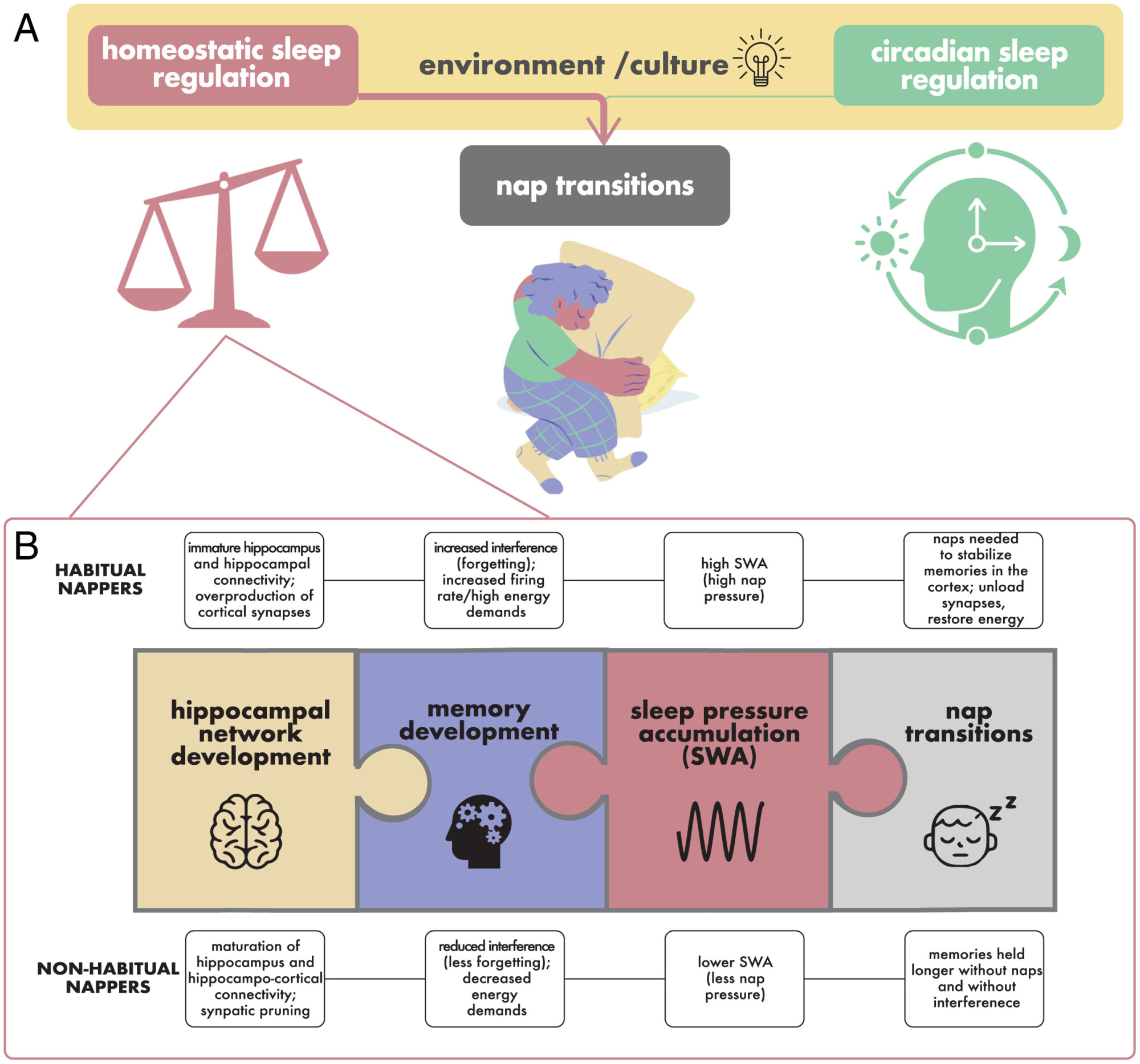
naps provide a solution to what is essentially a memory problem; high learning demands on an immature system create an overproduction of synapses that reaches its peak in early childhood. Sleep has been argued to help meet space and energy challenges associated with development (40, 41). Thus, we posit that early childhood is a time of competing demands of learning, which loads the brain (the hippocampus in particular), and sleeping, which may unload synapses across the cortex.
They authors provide a great diagram which synthesizes their argument:
The hippocampus is only one of the structures implicated in learning, but it is specifically implicated in emotional memories. Slow wave activity (SWA)— deep sleep— is associated with this type of learning. Here’s my favorite passage in the article:
“Interestingly, SWA in children’s naps predicts the overnap protection of memory for emotional faces (80) and also, predicts reductions in the emotional attention bias following a nap in young children (81). We posit that consolidation of emotional memories from the morning decreases emotional load, and as a result, children are less reactive to emotional stimuli thereafter. This provides a potential explanation of the oft observed phenomena that habitually napping children are emotionally dysregulated at the end of the day if they do not nap (the “witching hour”).”
So, this is a potential explanation why your child may be FREAKING OUT if they miss a nap. They have not been able to process all the emotions and feelings from the morning.
Translating Science into Daily Life
Here are a few things that this article does not suggest:
- That giving up naps earlier or later is associated with a child’s intelligence or memory.
- That you should try to stop your child from napping at a younger age to help their memory.
Every child matures at a different rate.
If you are struggling with naps, here is some good advice
- If naps cause bedtime chaos: Try capping nap length or switching to quiet time. Quiet time meets low stimulation play-- think sitting in bed and looking at books or playing with toys.
- If your child is exhausted without naps: Keep them as long as they’re helpful.
- If daycare mandates naps but napping means your child will be up until 10pm on weeknights. : Ask if your child can rest quietly with books or a blanket.
The Bigger Message
Every child’s timeline is different; nap transitions are developmental, not moral victories. Don't judge your child by what your friend's child is doing. Likewise, parents often feel guilty when naps vanish early — this is common (although frustrating) and not cause for concern.
If your child is in the middle of this transition, I’d love to hear what’s working for you. Drop a comment below or join the conversation on Instagram, TikTok or (help me out) Youtube.
For more on nap transitions and sleep science, check out Episode 15 of The Sleep Edit (the YouTube version has some useful graphics) or my blog post on nap problems.
References for nap table
- Staton S, Rankin PS, Harding M, et al. Many Naps, One Nap, None: A Systematic Review and Meta-Analysis of Napping Patterns in Children 0-12 Years. Sleep Medicine Reviews. 2020;50:101247. doi:10.1016/j.smrv.2019.101247. PMID: 31862445
- Spencer RMC, Riggins T. Contributions of Memory and Brain Development to the Bioregulation of Naps and Nap Transitions in Early Childhood. Proc Natl Acad Sci U S A. 2022;119(44):e2123415119. doi:10.1073/pnas.2123415119. PMID: 36279436
- Newton AT, Reid GJ. Regular, Intermittent, and Spontaneous: Patterns of Preschool Children's Nap Behavior and Their Correlates. Sleep Medicine. 2023;102:105-116. doi:10.1016/j.sleep.2022.12.019. PMID: 36640556
- Mindell JA, Leichman ES, Composto J, et al. Development of Infant and Toddler Sleep Patterns: Real-World Data From a Mobile Application. J Sleep Res. 2016;25(5):508-516. doi:10.1111/jsr.12414. PMID: 27252030
- Athanasouli C, Stowe SR, LeBourgeois MK, Booth V, Diniz Behn CG. Data-Driven Mathematical Modeling of Sleep Consolidation in Early Childhood. J Theor Biol. 2024;593:111892. doi:10.1016/j.jtbi.2024.111892. PMID: 38945471
- Acebo C, Sadeh A, Seifer R, et al. Sleep/Wake Patterns Derived From Activity Monitoring and Maternal Report for Healthy 1- To 5-Year-Old Children. Sleep. 2005;28(12):1568-77. doi:10.1093/sleep/28.12.1568. PMID: 16408417
Originally published November 2025. Last reviewed/updated by Dr. Craig Canapari, MD in March 2026
No spam, no sharing to third party. Only you and me.