Toddler Night Wakings: What Causes Them and How to Fix Them

Toddler night wakings are especially painful as they can cry longer than infants, and are harder to reassure than older children. One of the most common causes of night wakings in infants, toddlers, and even older children is inappropriate sleep onset associations. This is a problem which will respond to behavioral management (aka sleep training).
Let me paint a picture for you. It's been a long evening in the Smith household. Jimmy is 14 months old. Every night, since he was an infant, his parents have rocked him to sleep every night and then put him in his crib, at around 8 PM. His parents put him to sleep, sit down to watch some television and try to relax, but they are dreading the night ahead. Just when they get into bed, around 11 PM, they hear Jimmy crying out. They rush into his room frantically to try to rub his back so he falls asleep more quickly. These awakenings occur for the rest of the night every hour to an hour and a half. When he gets up for the day at 5:30 AM, Jimmy is quite irritable, and his parents are exhausted. They don't have the luxury of taking two naps today. Jimmy's problem is that he has developed inappropriate sleep onset associations, the most common cause of frequent night time awakenings in toddlers.
It’s important to note, however, that many other problems can cause crying and screaming at night in toddlers. Read on and see which may fit your child the best. Note that some children have more than one issue going on at a time. As always, if you are having trouble teasing out the cause of your child’s crying, check with your child’s pediatrician.
Want to learn more? We discussed this in the Sleep Edit podcast episode on night wakings.
Inappropriate Sleep Onset Associations Cause Frequent Awakenings
The typical child with inappropriate sleep onset associations is between 6 and 36 months but may be older or younger. This child needs his parent present to fall asleep and wakes up very frequently during the night. Parents view the awakenings as the problem, but they are a symptom of the primary issue: the child has not learned to fall asleep by himself.
In a nutshell: if your child needs you to fall asleep at bedtime, then needs you there to go back to sleep in the middle of the night, you are likely dealing with a sleep onset association. The fix is teaching your child to fall asleep without you, a process we call sleep training.
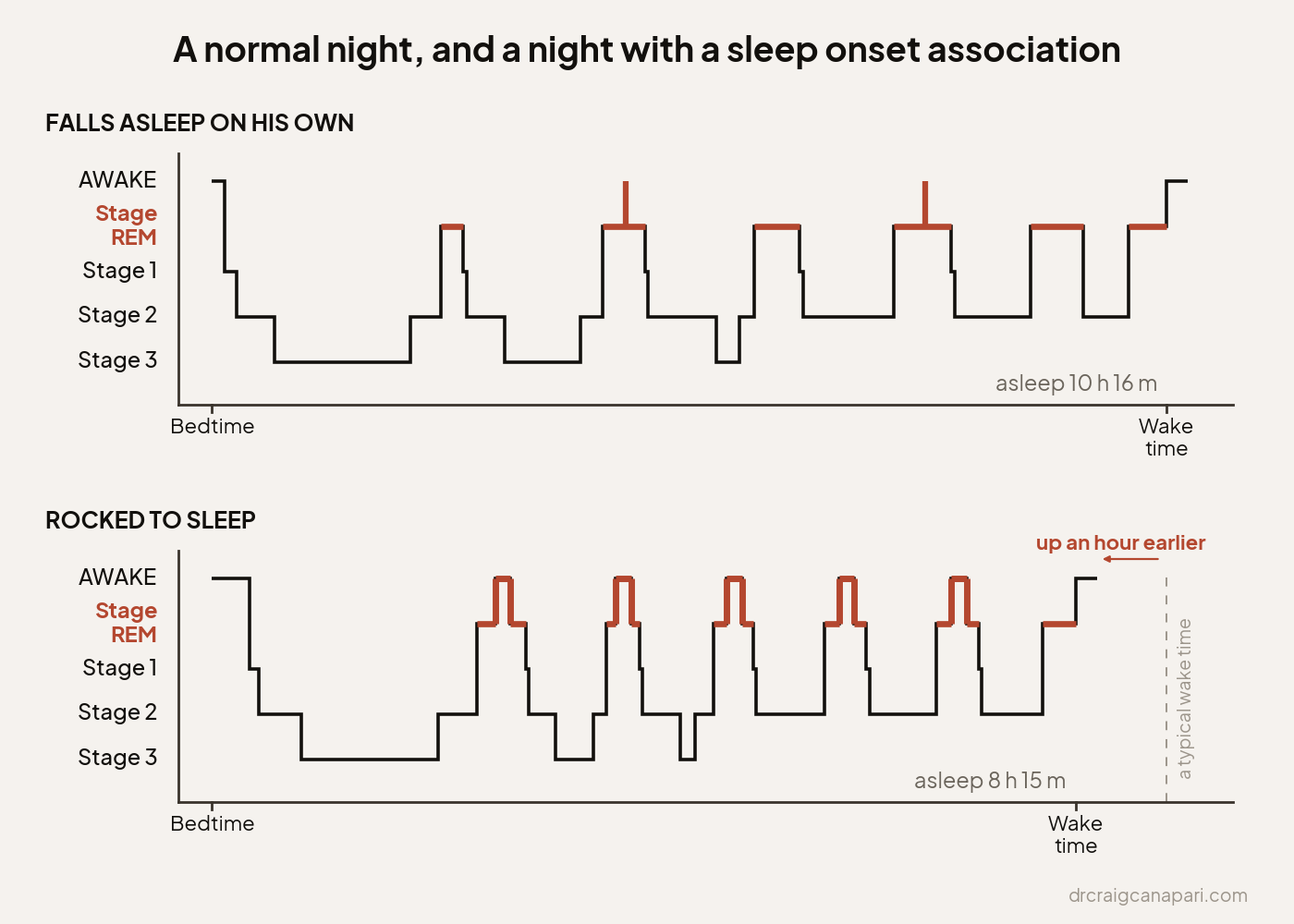
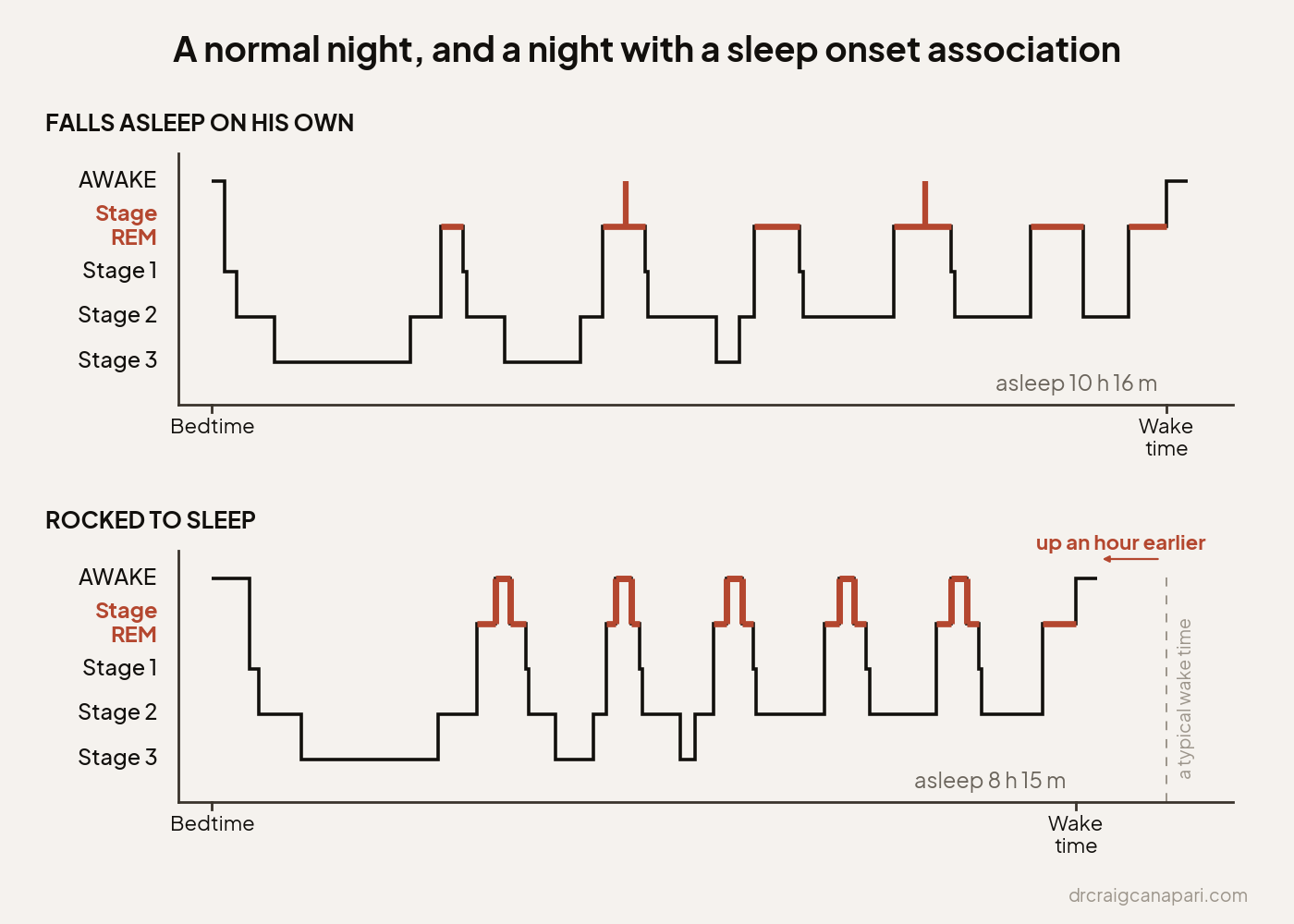
To understand why this is the case, I've created a few illustrations.
First, let's look at a night of normal sleep, on a graph called a hypnogram, which represents the various stages of sleep that a child goes through at night. Notice that the child falls asleep into very deep sleep at the beginning of the night, then has more REM or dream sleep as the night goes on. (REM is highlighted in red.)
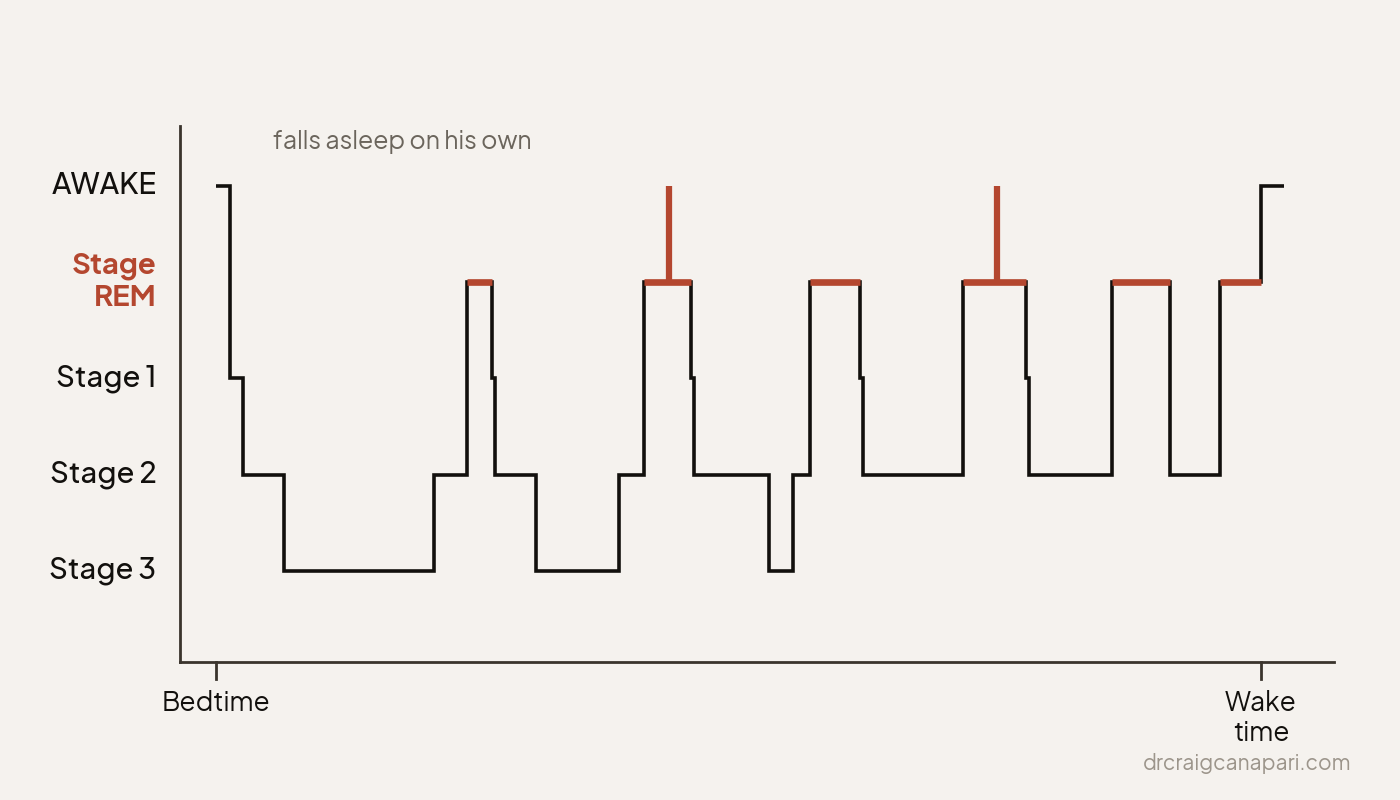
Note that the child briefly awakens after bouts of REM sleep. However, this child is used to falling asleep on his own. Thus, he does not signal to his parents.
Compare this with a child who needs her parents present to fall asleep. She may be held and rocked until she falls asleep. She may need his back rubbed or to nurse to fall asleep. She may even fall asleep with a pacifier in her mouth which falls out during the night. In Jimmy's example, his parents rock him to sleep.
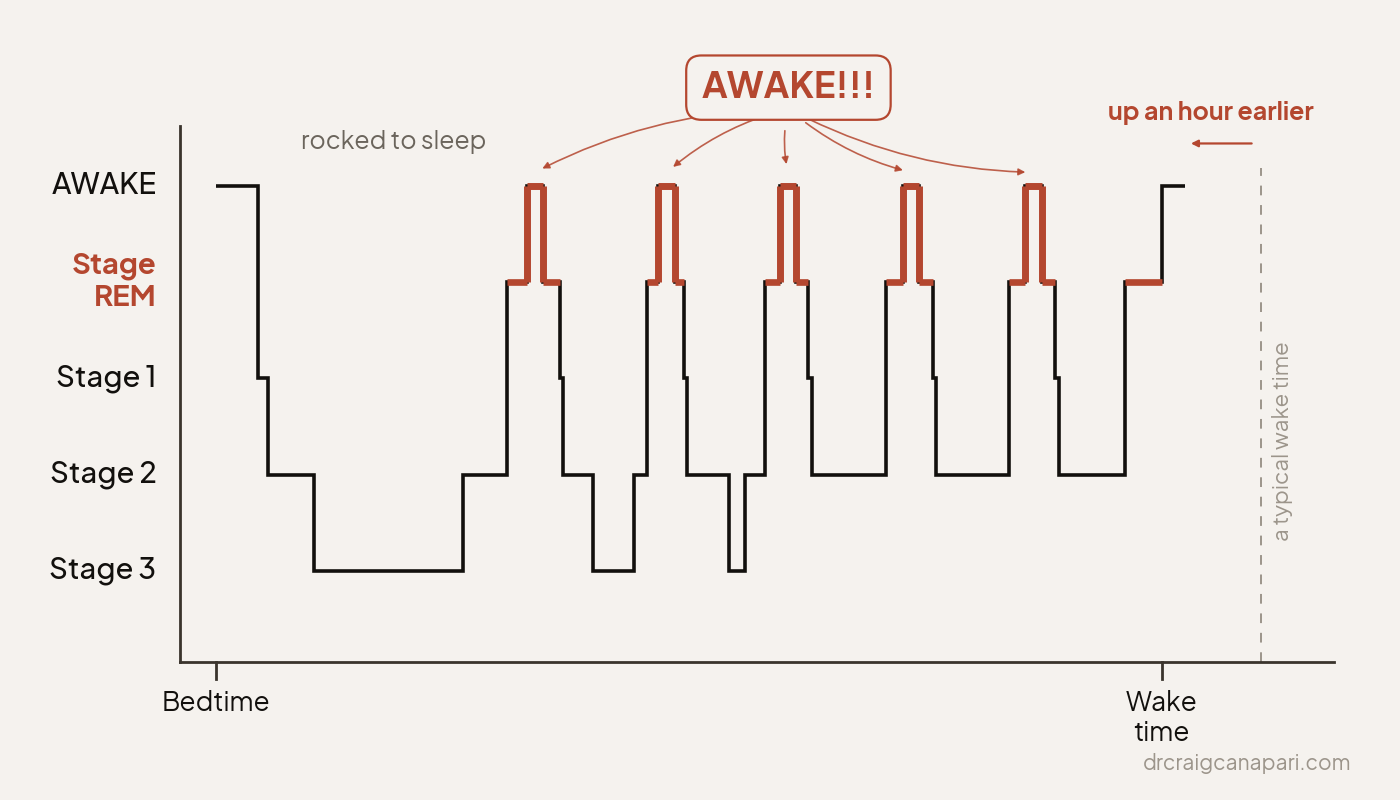
This child has not yet learned to fall asleep by herself. Thus, every time she has a normal awakening, she will call out to her parents and need them present to fall back to sleep. If your child falls asleep under a set of circumstances that are not present during the night (being held, having their back rubbed, nursing, even having a pacifier in their mouth) they will need the same set of circumstances multiple times during the night. So if they falls asleep in your arms, you are likely going to have to get up multiple times during the night. Often, they wake up earlier as well as exhausted parents bring them into bed with them (thus causing another sleep onset association). Thus, sleep onset associations are a common cause of early morning awakenings.
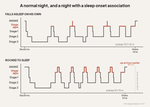
Here's a comparison of the two nights of sleep:
Common sleep on associations include:
- Rocking to sleep
- Laying down with a parent
- Falling asleep in parent’s bed
- Feeding or nursing to sleep
- A pacifier, blanket, or lovey that gets lost during the night
- A music source that turns off after the child falls asleep
Dr. Ferber used a great analogy in his classic book (affiliate link). Most of us fall asleep with a pillow and blanket. If we woke up and our pillow and blanket were missing, we would get up and go looking for them. We would likely worry about where they had gone
The key to addressing inappropriate sleep onset associations is helping your child to fall asleep on their own. For more advice, please see my post on various sleep training methods.
Note that a subset of children may have significant separation anxiety that persists as they get older. The practical way to determine if separation anxiety is a problem is that-- do they need help settling to sleep (with rocking or a pacifier) or is distress about your absence specifically? Often separation anxiety is focused on one parent predominantly. Often parents make concessions to their child’s anxiety (called accommodations) which can perpetuate the problem. The end result can be persistent cosleeping. Here’s an article on how to stop co-sleeping, even if your child is anxious.
The technical classification of sleep onset association problems
Once upon a time, when I was a wee sleep doctor, we used to classify these sorts of problems as behavioral insomnia of childhood, which had two subtypes: sleep onset association disorder (covered above) and limit setting disorder , which is where a child would come out of their room multiple times demanding parental attention, a phenomenon called “curtain calls”. The fact is, curtain calls often occur in children have moved to a bed and also have sleep onset association disorder, so now these issues are grouped under the diagnosis of chronic insomnia provided they have happened for three months or more.
Night terrors: another reason why your toddler wakes up screaming
Has your child woken up crying and screaming inconsolably? And nothing you did was able to stop them from crying? If so, they likely are having a night terror. Night terrors are part of a group of disorders called NREM parasomnias. (NREM means they occur out of non-REM sleep stages, and parasomnias are behaviors that occur out of sleep but have features of things you do during wakefulness.)
Night terrors are common in toddlers, occurring in one third of 18 month olds, falling to roughly one in five by age two and a half. They really stink! My son used to have one every time we slept at my in-laws and he would wake up the whole house.
They are pretty easy to differentiate from sleep onset associations, however. First off, they occur out of NREM sleep. Remember how we discussed the long period of deep sleep at the beginning of the night? That is the most common time for night terrors to occur, although they can occur later in the night.
More importantly, you cannot console your child during them. Sleep onset associations? Rocking your child back to sleep works-- that’s the whole trouble; you’ll be doing it again in two hours. Night terrors? Buckle up as they will be screaming and crying no matter what you do. They typically last 10-15 minutes but can last up to 30 or 40 minutes. The upside is that generally, night terrors don’t occur nightly (although they can) and usually only occur once per night. And they are usually benign and resolve on their own.
The main thing is to keep your child safe. Generally they stay in the crib or bed (if they leave the bed, it is technically sleepwalking), but they may still thrash about.
Here’s an article I wrote on sleepwalking and night terrors in children.
Did something temporarily disrupt a good sleeper?
A few causes of night time awakenings just happen in the course of normal family life and don’t typically need much intervention from parents. But they can still cause a problem if you respond by creating a new sleep onset association.
Are you dealing with a sleep regression?
If your child has been sleeping well then started waking up out of the blue, you may be dealing with what everyone calls a sleep regression.
Now, to be clear-- these disruptions are very real. You know: you were up at 3 a. m.for no obvious reason after 3 months of solid sleep with a fussy 18-month-old. I’m just not a believer in the purported age based predictable regressions that are all over social media. When researchers track night wakings over time, they decline steadily-- there is no bump at 12 months, 18 months, or 2 years. What I do know is that big-ticket developmental milestones (most famously walking and potty training) may be associated with short night wakings. And look how many happen during toddlerhood, as well as how they line up with purported age based sleep regressions.
| Age | What parents call it | What's actually going on |
|---|---|---|
| 12–15 months | "the 12-month regression" | Independent walking (typical 12–15 months, normal range 9–18). Pulling up and cruising just before. Often still on two naps and starting to fight the second. |
| 15–18 months | "the 15- or 16-month regression" | The 2-to-1 nap transition — most common in this window (range 12–24 months). Separation awareness sharpens. First molars erupting (13–19 months). |
| 18–24 months | "the 18-month or 2-year regression" | Autonomy and limit-testing arrive. Canines erupt (16–23 months). Climbing out of the crib becomes physically possible. |
| 2–3 years | "the 2-year or 2.5-year regression" | Crib-to-bed transition (often forced by climbing out, or by a new sibling). Potty training. Second molars erupt (23–33 months) — the last teeth, and the most blamed. Imagination and night fears begin. |
| 3–3.5 years | "the 3-year regression" | Dropping the nap (commonly 3–5 years). Total sleep need falls to roughly 10–13 hours. Night fears more prominent. Preschool starts — new schedule, new separations. |
Plenty of what disrupts toddler sleep isn't pegged to an age at all: illness, travel or a schedule change, a new sibling, a house move, a new caregiver.
The problem with the age-based framing is that it makes parents worry about things that may never happen. So before some scaremongering post about the Halloween sleep regression or the Mercury in retrograde sleep regression, take a breath and recognize the exciting developmental work your child is doing (which may have the cost of a few nights of disrupted sleep).
If you do nothing, these events tend to resolve on their own. But if you respond to them by, say, getting in the habit of rocking your child back to sleep, you may generate a new sleep onset association and cause the night wakings to persist.
I have a comprehensive post on the problems with age-based sleep regressions, as well as recognizing and addressing sleep regressions.
Is your toddler sick right now?
This isn’t rocket science. If your child has a cold or fever, sleep disruption is common. Nasal congestion and ear pain are both worse when lying down. If your child is sick, just soothe them and take care of them. Obviously call your pediatrician if you are worried. This too shall pass (until the next cold).
Just be a bit wary-- if you take your child into your bed for a week when they have a cold, you run the risk of creating another sleep onset association you may need to unpack later.
Is it teething?
Teething is commonly blamed for sleep problems. However, it generally only causes local, mild and brief symptoms of irritability around tooth eruption. Think maybe a night or two. And, importantly, teething does not cause fevers although it can nudge the temperature up slightly. If your child is having fevers or seems unwell, don’t just attribute it to teething; call your pediatrician.
Is there a new baby in the home?
Some parents struggle with their toddler's sleep when a new baby comes into the home. If the children share a room, this can be especially challenging. (Of course in early infancy, your infant should likely sleep in your room, provided that you can do so safely). If you have a small home, a crying infant in another room can wake up your toddler, so using a sound machine can be helpful. Just mind the volume and where you place it.
Sometimes, just the stress of welcoming a new baby to the home can disrupt your child's sleep. Usually, these disruptions are brief and last less than a week. If you can spend some time during the day with your toddler (and without the baby), that can help your child feel secure and calm as she goes through the exciting process of welcoming a baby brother or sister to the home.
Is a medical disorder waking your child?
Many common and chronic medical problems are overlooked as a cause of sleep disruption. I’m not talking about things that last for a night or two. I’m talking about problems that either occur multiple times per week, or in the context of a known chronic medical problem. You may be aware of the condition, or the night time symptoms may be your first clue that you need to chat with your child’s pediatrician.
For example, if your child coughs frequently at night they may have asthma which needs to be treated. Acid reflux can be associated with belly pain and vomiting at night. Obstructive sleep apnea is a very common problem associated with snoring which can disrupt sleep.
Is the schedule or the environment the problem?
Sometimes, there are some structural issues that you can address to help your child sleep better.
Is your toddler waking up hungry?
Toddlers should not need to eat during the night unless there is a medical reason for them to eat. (If you are concerned about your child's growth, please talk to your pediatrician about this). If you are giving your child a bottle of milk or breast feeding your child during the night, weaning these feeds will likely help improve your child's sleep rapidly. Here is my comprehensive post on dealing with night feeds.
Still feeding at night?
Night feeds are one of the most common reasons night wakings persist. My weaning guide has the exact bottle taper I use in clinic, plus approaches for breastfeeding families. Free for members.
Get the weaning guide →Is your child in bed for too long?
Some kids suffer from "too much time in bed syndrome". (I’m shamelessly borrowing this phrase from Brett Kuhn, whom I heard use it in a talk many years ago). This happens when parents keep the same schedule their toddler had at twelve months, even though the child now needs less sleep. Imagine a child who was sleeping from 6 PM to 6 AM at age 1. At age 3, this is likely too long a sleep opportunity, especially if the child is still napping. This child's sleep needs may have decreased from 13 to 11 hours per 24 hour period. Thus, if you keep the same nocturnal sleep period, your child may be awake for an hour or two at night. Usually in this scenario, your child is happy when she wakes up at night and is well rested in the morning. This may be the right time to get rid of a nap or consider a later bedtime. For more information, here's my post on how much sleep kids need.
Is the environment waking up your child?
Environmental cause tend to be obvious. Is there a or other electronic device on in the room? If so, please take it out of there. Is there loud noise from neighbors or the road outside? Does your child share the room with a sibling or parent who makes a lot of noise? Room sharing with siblings can make it particularly challenging to manage toddler night wakings. If one child wakes up, frequently the other does too. Here's more information on how to navigate the tricky waters of room sharing.
Not sure which sleep training method fits your child?
My free quiz matches your child's age and temperament to the right approach — and free membership includes the full 8-lesson Sleep Training Starter Kit to walk you through it.
Find your method →In summary
Night wakings in toddlers are painful and common. If your child needs your help to fall asleep at bedtime, teaching them to fall asleep via sleep training will help them sleep through the night in a matter of weeks. So you can sleep through the night as well. If they fall asleep independently, there are other causes you can address. If you found this article helpful, please share with your friends and family.
Originally published September 2026. Last reviewed/updated by Dr. Craig Canapari, MD in September 2026
No spam, no sharing to third party. Only you and me.