Melatonin and Heart Failure? Why I’m Not Losing Sleep Over the Headlines"

Originally published in my newsletter on November 5, 2025. If you find this useful, you can sign up here.
A reporter from The Washington Post recently reached out to me about a new study that’s been making some dramatic headlines—like this one from People Magazine:

You can read the American Heart Association press release here and the research abstract here.
Here’s what the authors did: they looked at anonymous health records from about 130,000 adults across several countries. They compared patients taking melatonin (meaning it was listed in their medication list) with patients not taking it.
Their conclusion sounded alarming:
“Long-term melatonin supplementation in insomnia was associated with an 89% higher risk of heart failure, a three-fold increase in heart failure–related hospitalizations, and a doubling of all-cause mortality over five years.”
That sounds scary—but I’m not losing sleep over it. Here’s why.
It’s not a published study
This is a conference abstract, not a peer-reviewed paper. At scientific meetings, most abstracts are accepted. Only a fraction ever make it to full publication after deeper review. Think of it as work in progress, not the final form the research will take place.
It only included adults
The data have no relevance to children or teens, which are my focus as a pediatric sleep physician.
Measuring melatonin use is messy
In the U.S., melatonin is over-the-counter. In other countries, it’s prescription-only. So many people in the “non-melatonin” group may have actually been taking it—just not recorded.
Correlation ≠ causation
Insomnia itself has been linked to heart problems like hypertension, coronary artery disease, and heart failure (see this study). So it may not be the melatonin that’s risky—it may be why people were taking it.
We’re missing key details
We don’t know:
- What doses were used
- Why patients were taking melatonin
- How severe their insomnia was
Other evidence points the other way
In fact, some research suggests melatonin might protect the heart.
The numbers sound worse than they are
- Heart failure: 2.7% → 4.6% (an 89% relative increase)
- Deaths: 4.3% → 7.8% (a doubling)
That’s not nothing—but it’s not a doomsday scenario either.
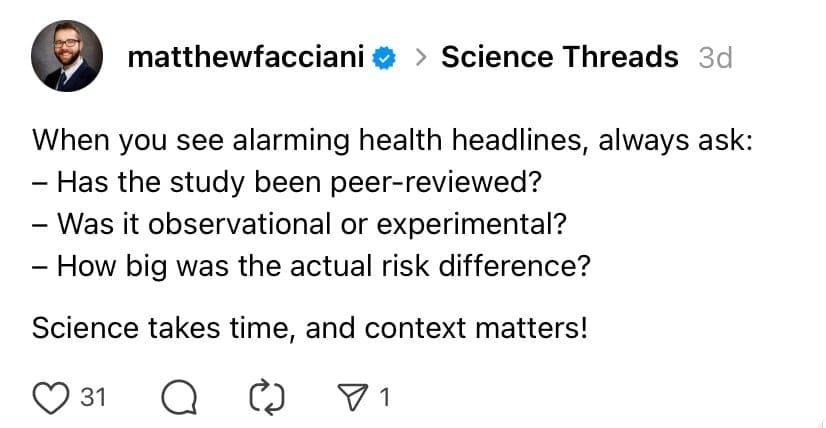
Social scientist Matthew Facciani summed it up well on Threads:
My take
I’ll keep an eye out for the full paper when it’s published—but for now, I’m not changing anything.
I still take a small dose of melatonin (1 mg) for my own sleep, and I still recommend it cautiously for kids who truly benefit.
Until there’s stronger evidence, this looks like a headline more than a hazard.
If you want a deep dive on what we actually know about melatonin, check out my full article:
Melatonin for Kids: What Parents Should Know
I also covered the most present risk for melatonin in children-- overdose.
We’ve also covered melatonin use and safety on The Sleep Edit podcast—you can listen here.
Sleep well,
Craig
Originally published November 2025. Last reviewed/updated by Dr. Craig Canapari, MD in November 2025
No spam, no sharing to third party. Only you and me.